Restaurant food cost you can trust: recipes, waste, and live inventory
Sturgeon costs every recipe from your latest invoice prices, deducts inventory as dishes sell in your POS, and subtracts waste as it's logged. Your food cost then reflects what actually earned revenue, and you see it on Friday instead of at month end.
How it works
Recipes costed from real invoices
Every recipe carries live stock and real measures. Ingredient prices come from your invoices in MarginEdge, so when beef goes up, the cost per portion and the margin move with it. Scale any recipe to any yield and convert between metric and imperial.
Inventory that deducts itself
When a dish sells in Toast, Square, or Clover, its ingredients come off stock on hand, and counts reconcile against what the walk-in actually holds. No clipboard.
Waste logged as it happens
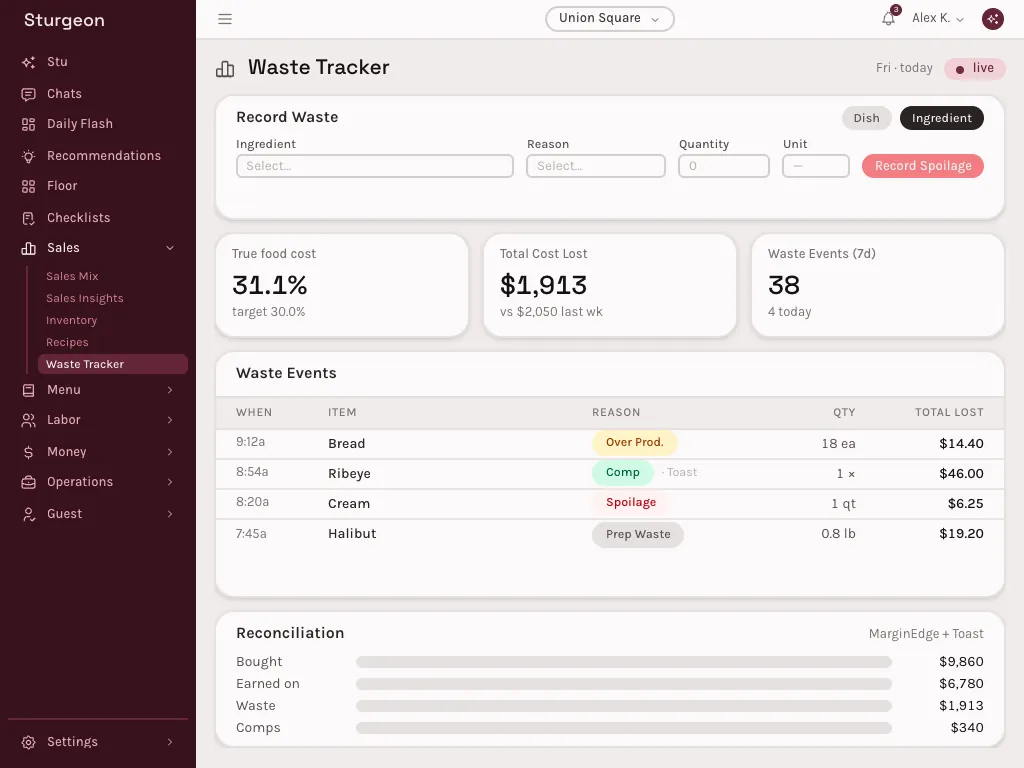
Spoilage, over-production, prep waste, and comps are recorded in seconds and priced at the last invoice, so every event carries its real cost.
True food cost, every day
Sturgeon subtracts waste from what you bought, so food cost shows what actually earned revenue against your target every day, while there's still time to act on it.
Questions
How do you calculate restaurant food cost percentage?
Food cost percentage is the cost of the food you used divided by food sales, times 100. The cost of food used is opening inventory plus purchases minus closing inventory. Sturgeon computes it daily from your recipes, POS sales, invoice prices, and logged waste instead of waiting for a month-end count.
What is true food cost?
True food cost is food cost with waste accounted for: what the ingredients in the dishes you actually sold cost, rather than everything you paid for. Sturgeon subtracts spoilage, comps, and over-prep from purchases so the number reflects what earned.
Does it work with my POS and MarginEdge?
Yes. Sales come from Toast, Square, or Clover, and ingredient prices from your MarginEdge invoices; Sturgeon connects to both with OAuth and API keys, with no data-migration project.
Guides on the numbers behind this
- Food cost percentageHow to calculate restaurant food cost percentageThe formula, a worked example, actual versus theoretical, and how to track it daily.
- Prime costWhat is prime cost in a restaurant, and how do you calculate it?Cost of goods sold plus labor, why operators watch it weekly, and how to read it.
- Recipe costingRestaurant recipe costing: how to calculate plate cost and menu priceYield, trim, the plate cost formula, and how to turn a cost into a menu price.
- Reducing food wasteHow to reduce restaurant food waste, and measure what it costsWhere waste comes from, how to log and price it, and the fixes that tend to work.
See your own numbers in Sturgeon in under a week, with your POS connected, your forecasts calibrated, and Stu answering. White-glove onboarding is included.
No credit card. No six-month contract. Your data stays yours.